
By TJ Grim, Ready 2 Respond Trainer
A pipe bursts in a mechanical room early Monday morning. Your facilities team has drying equipment on hand, but the extractor is missing a hose, the dehumidifier filter is visibly soiled and needs to be replaced, and half of the airmovers are stored in another building.
Owning water response equipment is different from having equipment ready to deploy. Extractors, airmovers, dehumidifiers, air scrubbers, and moisture meters give facilities teams the tools to respond to clean water incidents in-house. With it, facilities staff can act quickly, limit moisture spread, and start drying without waiting for outside resources.
Between deployments, small maintenance, storage, or inventory problems can go unnoticed. What seems minor during routine operations can cause costly delays when a supply line fails or an HVAC system leaks.
For facilities that rely on internal response capabilities, keeping equipment readiness to deploy is an ongoing responsibility. Here are five common misconceptions to clear up before the next water event.
Myth #1: “If we own the right equipment, we’re ready.”
Fact: Equipment readiness depends on more than what’s sitting in the storage room.
Purpose-built structural drying equipment provides the extraction capacity, airflow, dehumidification, continuous performance, and durability needed during a water event. But it only helps if it’s available and working when needed.
Picture a freeze-up causes a plumbing leak on the fourth floor at 5 a.m. There’s an extractor, but the wand is in a building across campus, and no one can locate the moisture meter. On paper, everything is accounted for. In practice, critical components are missing when they’re needed most.
A response-ready team knows:
- What equipment they have
- Where each piece is located
- Whether it has been fully serviced and is functioning properly
- What accessories and supplies each unit require and whether they’re stocked
- Who is responsible for maintaining and tracking it
This is especially important across large campuses, healthcare systems, multi-family properties, and other facilities where equipment may be distributed across multiple locations.
Myth #2: “If it worked last time, it’ll work next time.”
Fact: Water response equipment needs attention between incidents.
Water response equipment is designed for demanding conditions and repeated use, but routine inspection and preventive maintenance help protect that investment and keep each component ready for the next deployment. Maintenance needs vary by equipment type:
- Dehumidifiers: Change dirty filters, inspect drain hoses, and check coils and pumps.
- Airmovers: Remove accumulated dust and debris, and inspect fans, grills, cords, and control panels for wear and damage.
- Extractors: Rinse after each use and check hose fittings, float valves, filters, and other components for damage or obstructions.
- Air scrubbers: Check filters, airflow, seals, and housings to keep airflow and filtration effective.
- Moisture meters: Keep fresh batteries on hand and perform a quick function check before each use.
Maintenance schedules should reflect manufacturer recommendations, equipment usage, and facility conditions. Brief inspections before and after use, combined with periodic functional testing, can catch wear, damage, and service needs before they become bigger problems early.
Seasonal conditions also matter. Equipment stored in trailers, warehouses, maintenance rooms, or other non-climate-controlled spaces may be exposed to cold temperatures, humidity, dust, construction debris, or even pests.
The goal is to identify and resolve equipment problems before the next incident, not after water is already on the floor.
Myth #3: “Cleaning equipment after a water event is just housekeeping.”
Fact: Cleaning is part of returning equipment to response-ready condition.
After a water event, it’s tempting to pack up the equipment, return it to storage, and move on to the rest of the to-do list. Skipping the equipment reset, however, can create problems the next time these tools are needed.
Equipment returning from a water event can carry dust, debris, residual moisture, or other material picked up during extraction and drying. Cleaning equipment before storage or redeployment helps keep tanks, hoses, grills, and other components ready for use while reducing the potential for cross-contamination between response locations. Tracking where equipment has been used helps ensure cleaning and handling are appropriate for the conditions encountered during each event.
Post-event cleaning is also an opportunity to reset the entire equipment kit. Return hoses, cords, attachments, and other accessories to their designated locations so the next team isn’t left searching for something that never made it back after the previous response.
A complete closeout process includes cleaning equipment, checking or replacing filters, and returning equipment to storage in response-ready condition.
Myth #4: “Where the equipment is stored doesn’t really matter.”
Fact: Equipment that can’t be accessed quickly can slow the entire process.
When water is actively moving through a building, every extra minute spent hunting for the right hose, attachment, or piece of equipment gives moisture more time to spread.
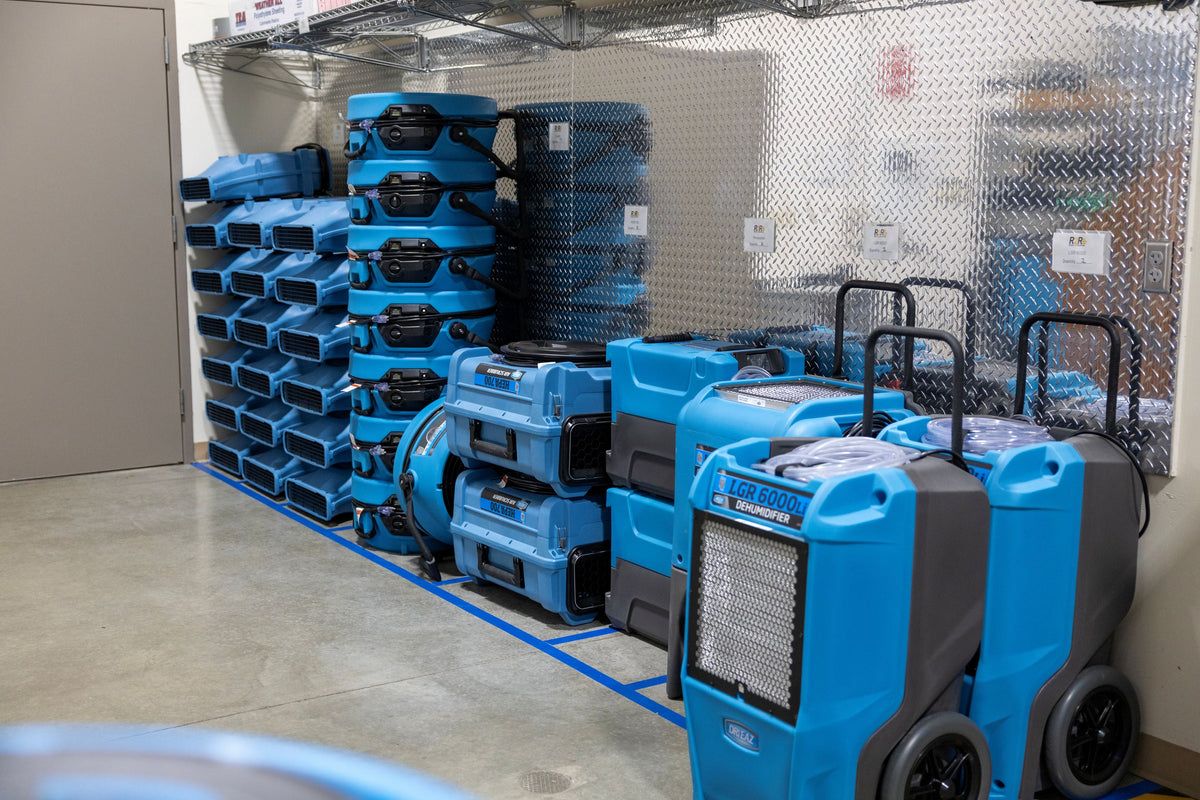
Response time should be a key consideration in where and how equipment is stored. A centralized storage location may work for a smaller property, while a large campus or healthcare system may benefit from smaller, strategically placed equipment kits or mobile response units.
Organization and physical access are just as important as knowing where equipment is stored:
- Clearly label all equipment so anyone responding can quickly identify and deploy it.
- Store frequently used accessories – such as hoses, filters, and PPE – with or near the equipment they support.
- Choose accessible locations that can be reached after hours and that are practical for moving larger units quickly to common incident areas.
- Keep response equipment clear of clutter so unrelated materials don’t crowd storage areas or block access.
Plan for power access, too. Multiple airmovers, dehumidifiers, and other drying equipment may be running at the same time. Understanding electrical requirements and identifying appropriate power sources in advance can help prevent tripped breakers and overloaded circuits.
Smart staging cuts the time between discovering a leak and starting extraction.
Myth #5: “Once the equipment is back in storage, the response is over.”
Fact: A water event should end with the response system reset for its next use.
Before fully closing out an event, account for every piece of deployed equipment and confirm that it has been returned to its designated location. Restock filters and other consumable supplies. Clearly identify any damaged equipment and remove it from service rather than leaving the next team to discover the problem during an emergency.
This is also an opportunity to capture lessons learned while the response is still fresh:
- Was the right equipment easy to access?
- Was anything missing or unavailable?
- Was there enough equipment and capacity to handle the scope of the event?
- Were there tools or supplies that could have made the response faster or easier?
- Did equipment need to be moved from another building or department?
- Was the event within the scope your team should handle in-house, or should outside help have been called sooner?
Those observations can guide practical improvements while the experience is still fresh. If the job called for 10 airmovers and only four were available, that’s a gap to close before the next event.
The final step is assigning clear ownership for follow-up actions. Everyone should know who is responsible for equipment check-in, maintenance, inventory updates, repairs, and restocking.
Build Readiness Between Water Events
A fast, in-house response starts well before a pipe breaks or flooding occurs. The right equipment provides the tools to act, but maintaining that capability requires attention between incidents.
Keeping equipment clean, serviced, organized, stocked, and easy to access removes avoidable friction when the clock is already running. When the next manageable clean water event occurs, teams can move directly into assessment, extraction, and drying with equipment that is ready to go.
Contact the R2R team to assess your facility’s water response equipment, identify readiness gaps, and develop tailored equipment, training, and response protocols.
For facility management tips, follow us on LinkedIn and subscribe to our Facility Insights newsletter.
###
Case Study: How Morgan State University Builds First-Hour Readiness